The indie4me long read
Twelve Months, Twelve Singles
In 1992 a band from Leeds equalled a chart record set by Elvis Presley, and almost nobody remembers. The Wedding Present built the least glamorous and most productive career in British indie — and made one of the strangest major-label albums ever released.
Words by Michele Harding · 19 September 2026
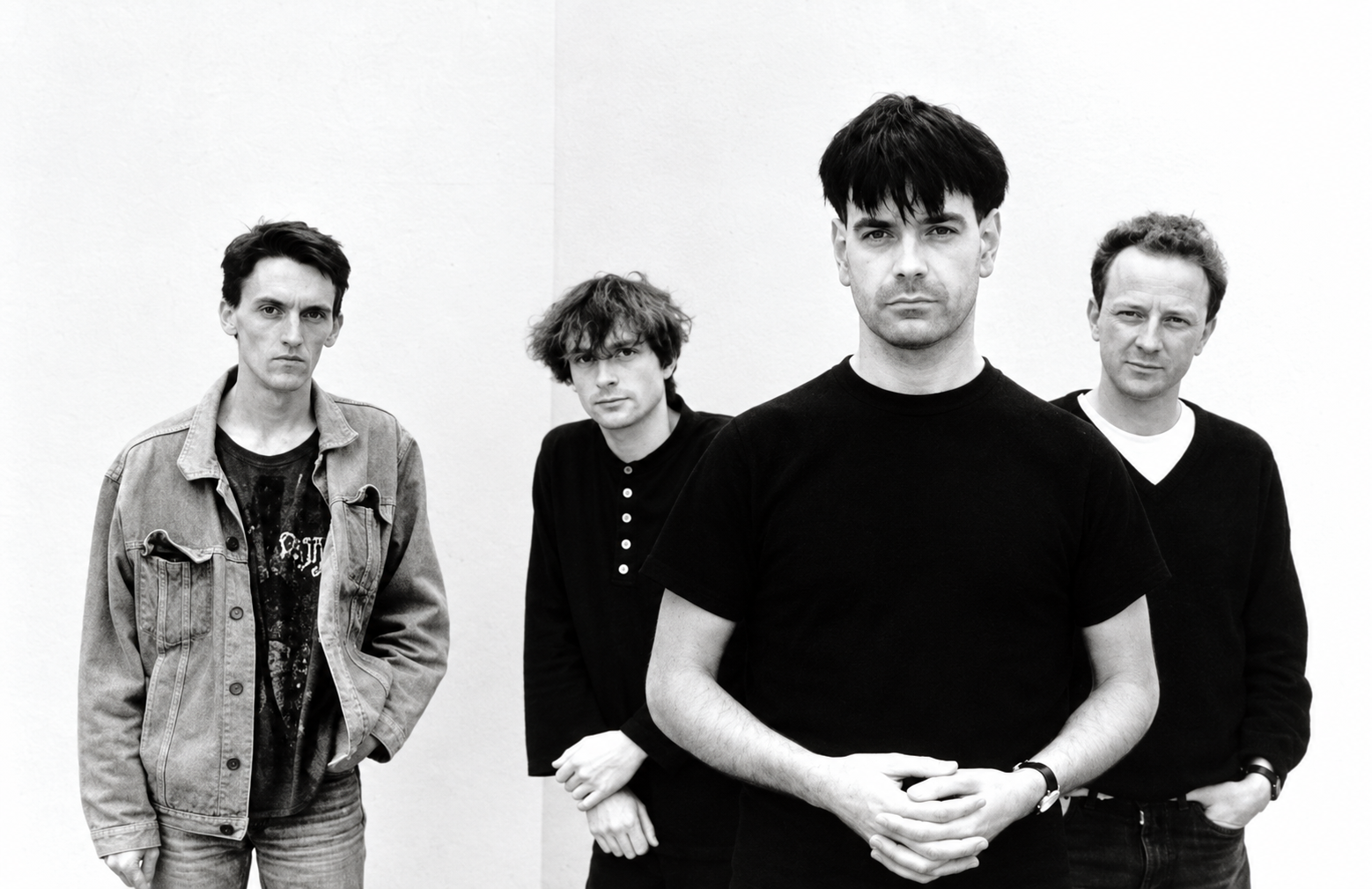
The thing about the record is that nobody talks about it.
In the twelve months of 1992, The Wedding Present released twelve singles — one a month, every month, each pressed in an edition of 10,000 copies and deleted almost immediately. Every single one charted in the UK top 30. It equalled a record set by Elvis Presley in 1957 for the most top 30 hits in a single calendar year.
There is a detail that makes it stranger. Presley's 1957 tally was padded with reissues and catalogue material. The Wedding Present's twelve were all new, original songs, written and recorded to a monthly deadline by four men from Leeds while also touring. The NME called the whole business "casually revolutionary," which is about right, and then British music moved on to Suede and everyone forgot.
This is the story of the band that did it.
An advert on a university noticeboard
David Lewis Gedge was born in Bramley, Leeds in April 1960 and raised in Middleton, on the southern edge of Manchester. He went back to Leeds for university and came out in 1981 with a BSc in Mathematics — the first person in his extended working-class family to go into higher education at all. He found his bassist, Keith Gregory, by putting an advert up at Leeds University Union.
Gedge and Gregory had been in a band called the Lost Pandas, which fell apart in 1984. What was left of it became The Wedding Present in 1985, with Peter Solowka on guitar and, eventually, Shaun Charman on drums.
The name was chosen by Gedge and his girlfriend, and it was chosen for being wrong. "I've always thought that the Wedding Present was an inappropriate name for a pop band — more like a poem, or a book or something — and therefore quite attractive." It is the only decision the band ever made that could be described as arty.
Everything else was logistics. They started their own label, Reception Records, and put out their first single, "Go Out and Get 'Em, Boy!", themselves. By the band's own account, the first batch was transported up to Yorkshire on a National Express coach. There is no better single image of what independent music actually meant in 1985 than a man with a box of his own records on a scheduled coach service.
The Manchester United problem
The debut album arrived on 12 October 1987, on their own label, produced with Chris Allison. It was called George Best, and it had George Best on the cover.
The photograph came out of a sports picture agency's filing cabinet, where Gedge found it while flicking through. "I saw that picture and thought it was a great LP sleeve." The choice was personal — "it was because of growing up in Manchester and being a Manchester United supporter." The band got Best's agent's details from the same agency, approached him through their press officer, and to their considerable surprise Best agreed not only to the sleeve but to a promotional photoshoot with the band, at which he appears to have been politely baffled by everyone involved.
The consequence was one that only makes sense in England. The album sold. The T-shirts did not — at least not at home. Gedge's account is blunt: "As soon as we got to Leeds, the sales just dropped." A Leeds audience, it turned out, would buy the record but would not wear a Manchester United legend across its chest.
George Best reached number 47. It is now routinely listed among the essential British indie debuts, and the NME placed it at 489 in its 2014 list of the 500 greatest albums ever made.
The strangest record RCA ever released
Here is the fact that ought to be better known than it is.
Peter Solowka's father was Ukrainian. During a John Peel session, Solowka played a traditional Ukrainian folk tune called "Hopak" — essentially as a lark. It went down well enough that Peel encouraged them, and the band gave over an entire session to Ukrainian folk music. Since none of them could sing in Ukrainian, they brought in a Leeds musician, Len Liggins, who could. Roman Remeynes of the band Hang the Dance joined after objecting — reportedly in good humour — to their reading of the material.
The results were collected as an album. Its Ukrainian title, Українські виступи в Івана Піла, translates John Peel's own name into Ukrainian: he becomes Ivan Pil.
It was meant to come out on Reception in late 1988, but the distributor Red Rhino went into receivership, the band signed to RCA, and RCA put it out in February 1989 instead. So a major label released an album of traditional Ukrainian folk songs, sung entirely in Ukrainian, by an indie band from Leeds.
It reached number 22 in the UK album chart. That is higher than their own debut had managed in English.
RCA, scenting something, wanted to release "Those Were the Days" as a commercial single and believed it would be a top ten hit. The band said no. Solowka, Liggins and Remeynes carried the idea on into a separate group, The Ukrainians, who are still going.
Albini, Minnesota, ten days
Bizarro followed in 1989 and did the conventional job — number 22, and a top 40 single in "Kennedy."
Then the band hired Steve Albini, went to Pachyderm Studio in Cannon Falls, Minnesota, and made Seamonsters in ten days in the snow. It is the record where the jangle curdles: quieter, heavier, more menacing, Gedge moving between a near-whisper and a shout within the same song. It reached number 13, their highest-charting album.
There is a small, revealing detail about it. The Wedding Present had been mocked for their song titles, which tended to be whole conversational sentences. On Seamonsters, every single track has a one-word title. It reads as a joke, a correction and a statement of intent all at once.
Also from this period, and worth knowing: Keith Gregory picked up a barely-distributed American single called Slay Tracks on a trip to the States, and the band covered a song off it called "Box Elder." The band who made it were Pavement, and this was before Slanted and Enchanted existed. The Wedding Present's version was for a while more widely available than the original, to the point that some listeners assumed Pavement had covered The Wedding Present.
The Hit Parade
Which brings us back to 1992.
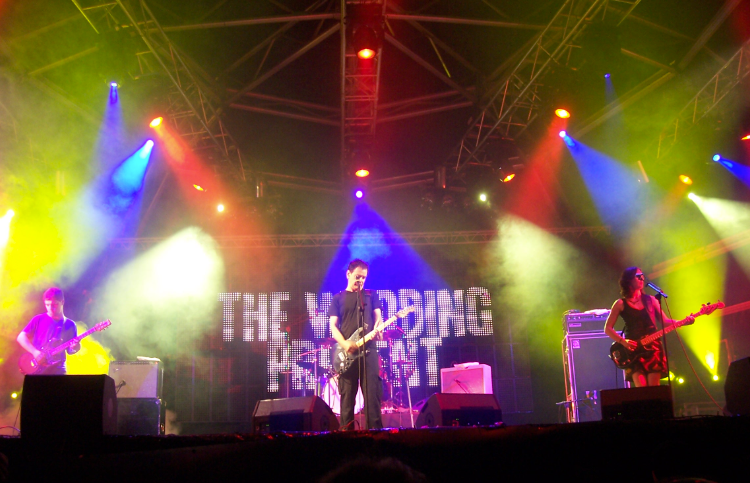
The plan was simple to state and brutal to execute: a new single on the first Monday of every month, 10,000 copies, then deleted. An original on the A-side. A cover version on every B-side — across the year they got through Bowie, Neil Young, the Go-Betweens, Altered Images, the Monkees, Isaac Hayes, Bow Wow Wow, Mud, Julee Cruise and Close Lobsters. Producers included Ian Broudie of the Lightning Seeds and Jimmy Miller, who had made records with the Rolling Stones.
The twelve, in order, and where they charted: "Blue Eyes" (26), "Go-Go Dancer" (20), "Three" (14), "Silver Shorts" (14), "Come Play with Me" (10), "California" (16), "Flying Saucer" (22), "Boing!" (19), "Loveslave" (17), "Sticky" (17), "The Queen of Outer Space" (23) and, in December, "No Christmas" (25).
Twelve for twelve. The collected singles came out as Hit Parade 1 and Hit Parade 2, which reached 22 and 19 respectively — meaning the band charted fourteen times in a year.
The deletion policy was the clever part and the honest part at once. It meant no single could be propped up by a long tail of sales; each had to do its work in its week. It also meant a generation of fans spent 1992 standing outside record shops on the first Monday of the month, which is a form of audience engagement no marketing department has since improved upon.
What the songs are actually about
It would be easy to make The Wedding Present sound like a novelty act of stunts and statistics. The reason they lasted is the writing.
Gedge writes about relationships with an almost uncomfortable specificity: not heartbreak in the abstract but the actual texture of it — the conversation that goes wrong, the thing you shouldn't have said, the suspicion you can't prove, the excruciating politeness of an ending. The songs are conversational, often one side of an argument, and frequently make the narrator the one at fault. Against guitars played at a speed that sounds like panic, it produces a very particular effect: emotional over-sharing at 200 beats per minute.
John Peel's verdict remains the best summary anyone has managed: "The boy Gedge has written some of the best love songs of the 'Rock 'n' Roll' era. You may dispute this, but I'm right and you're wrong!"
Peel put his airtime where his mouth was. The Wedding Present recorded thirteen Peel sessions between 1986 and 2004 — the fourth-highest total of any act, behind only The Fall's twenty-four, Ivor Cutler's twenty-two and Loudon Wainwright III's sixteen.
Still going
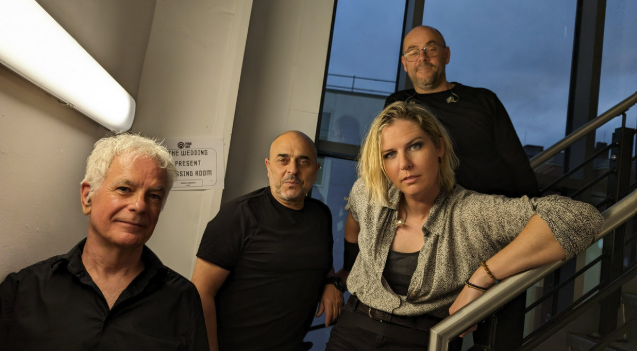
The band stopped in January 1997, playing their last show of the original era in Liverpool. Gedge formed Cinerama, which was gentler, more orchestrated and more cinematic, and for a while he refused to play Wedding Present songs at all. Gradually they crept back into the set, and in September 2004 he simply renamed the band, keeping the same line-up.
Take Fountain followed in 2005, and El Rey, Valentina and Going, Going... after that. In 2022, thirty years on, Gedge did the whole thing again: a project called 24 Songs, monthly releases across the year. In 2025 a stage musical, Reception, premiered in Leeds.
Gedge is the only constant member, and has been since 1985. That is the real achievement, and it's less photogenic than the Elvis record: forty years of running a band as a going concern, mostly outside the major-label system, without ever having a hit anyone would call famous.
The Smiths made the case that an independent guitar band could be enormous. The Wedding Present made the less romantic and possibly more useful case — that one could simply keep going.
Sources
- The Wedding Present — Wikipedia
- The Wedding Present discography — Wikipedia
- Official biography — Scopitones
- David Gedge — Wikipedia
- George Best (album) — Wikipedia
- The Cover Uncovered: The Wedding Present and George Best — Far Out
- Ukrainian John Peel Sessions — Wikipedia
- The Ukrainians — Wikipedia
- Seamonsters — Wikipedia
- Hit Parade 1 — Wikipedia
- The Wedding Present covered Pavement before anybody knew who that was — AV Club
- List of Peel Sessions — Wikipedia
A record sung entirely in Ukrainian reached number 22 in the British album chart.