Origins
Thirty Thousand Copies
Everyone repeats the line about the first Velvet Underground album: nobody bought it, and everyone who did started a band. The truth is more interesting — and the story runs through a Welsh mining village, a London acetate, and almost everything British indie did afterwards.
Words by Michele Harding · 19 September 2026
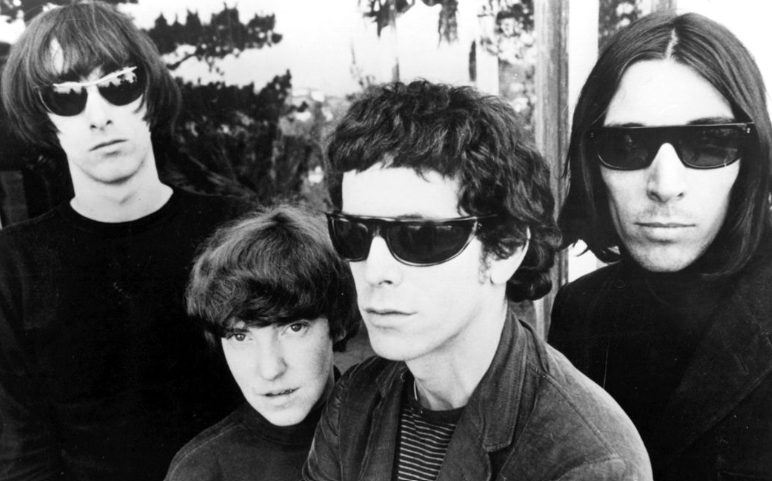
The most repeated sentence in the history of independent music is this: the first Velvet Underground album sold almost nothing, and everyone who bought a copy started a band.
It is worth getting right, because it is the founding scripture of the thing this archive documents. Brian Eno said it in a telephone interview with the Los Angeles Times in May 1982. His actual words were: "I think everyone who bought one of those 30,000 copies started a band!" The figure was Lou Reed's — Reed had said the record sold about 30,000 copies in its first five years. Over the following decades the line got shorter, snappier and less accurate; the sales figure drifted to 10,000, or 60,000, or vanished. Reed himself, asked about it in 1989, called it a joke and declined to claim it.
Later research has suggested the real number may have been closer to 200,000 by 1971 — which would make the album an underperformer rather than a catastrophe. But the myth did the work anyway. It gave two generations of British musicians permission to believe that sales figures and importance are different quantities. Nearly everything in this archive proceeds from that idea.
So here is the band the idea came from.
A miner's son from Garnant
John Davies Cale was born on 9 March 1942 in Garnant, a coal-mining village in the Amman Valley in Carmarthenshire. His father was a miner who spoke only English. His mother was a primary school teacher who spoke Welsh and raised her son in it. Cale did not learn English until he started school at around seven years old.
He took up the viola, joined the National Youth Orchestra of Wales at thirteen, and won a scholarship to Goldsmiths College in London, where he organised one of the earliest Fluxus concerts in Britain and conducted the first UK performance of John Cage's Concert for Piano and Orchestra. In 1963, on Aaron Copland's recommendation, he went to America.
Within weeks of arriving in New York he took part in an eighteen-hour-and-forty-minute marathon performance of Erik Satie's Vexations, alongside Cage. He then joined La Monte Young's Theatre of Eternal Music, an ensemble devoted to sustained drones held for hours at a time.
This matters because it is the ingredient nobody else in rock and roll had. The Velvet Underground's sound is often described as New York bohemian nihilism. Half of it is a Welsh viola player applying minimalist drone theory to a rock band.
The accident of the ostrich
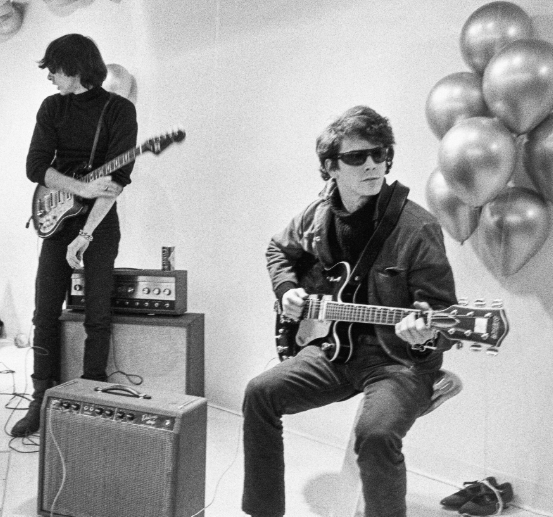
Lou Reed was, at that point, a staff songwriter at Pickwick Records, a budget label that churned out quick imitations of whatever was selling. One of his throwaways was a dance-craze novelty called "The Ostrich," recorded with a guitar tuned so that every string sounded the same note.
Pickwick needed a band to perform it, and someone recruited the odd-looking classical musicians hanging around downtown. Cale took the job. And when he heard the tuning — one note, all strings, ringing endlessly — he recognised it immediately. It was a drone. The commercial hack job Reed had knocked out to pay the rent was, by pure accident, built on the same principle Cale had been studying seriously for years.
That is the entire origin of the band: two people discovering that their opposite ambitions produced the same sound.
Reed's college friend from Syracuse, Sterling Morrison, joined on guitar. Angus MacLise came in on percussion. They were called the Warlocks, then the Falling Spikes, and in November 1965 they took a new name from a paperback about unusual sexual practices that Tony Conrad had picked up.
MacLise then quit, on the grounds that the group had been offered money to play at a specific time, which he regarded as a betrayal of the principle of the thing. He was replaced by Maureen Tucker, who played standing up, used mallets, largely dispensed with cymbals, and thereby invented a rhythmic approach that half the bands in this archive have since borrowed.
The banana
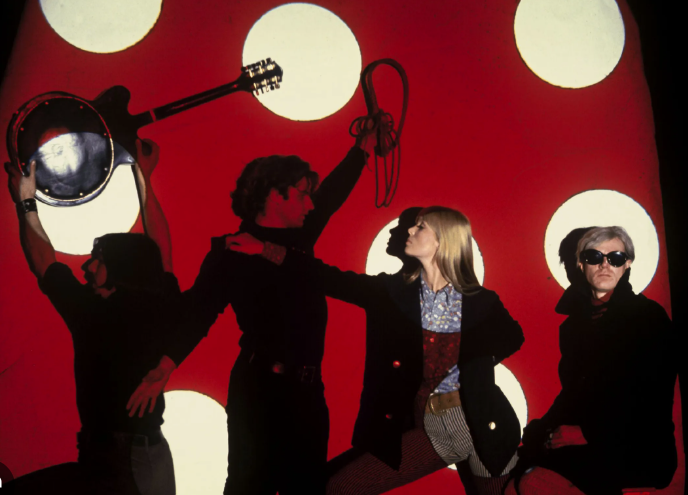
Andy Warhol became their manager in 1965, installed them as the house band of his Exploding Plastic Inevitable, and insisted they add a German singer called Nico. He got them a deal with Verve, took the producer credit, and mostly left them alone — which, under the circumstances, was the single most useful thing he could have done.
The Velvet Underground & Nico was recorded across four days at Scepter Studios in New York in mid-April 1966, for somewhere between $1,500 and $3,000, partly financed by a Columbia Records sales executive named Norman Dolph. Columbia, Atlantic and Elektra all declined to distribute it.
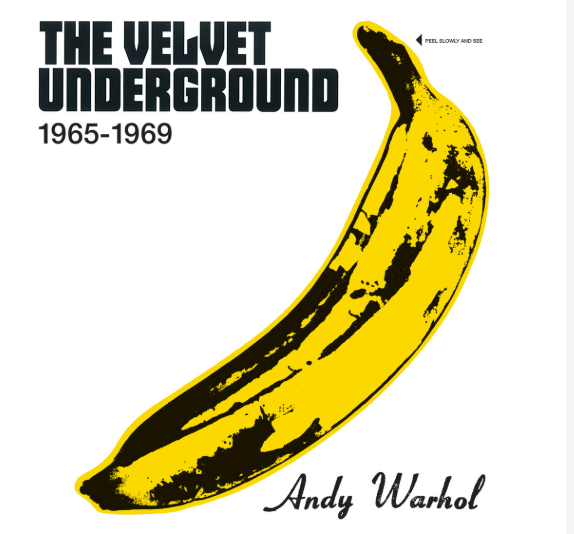
Then the cover nearly destroyed it. Warhol's banana was not printed but applied as a peel-off sticker — "Peel slowly and see" — revealing a pink banana underneath. A special machine was needed to assemble it, and the delay pushed the release back. The band's name did not appear on the front at all. And when the record finally emerged in March 1967, the actor Eric Emerson, whose image appeared on the back without permission, threatened to sue for $500,000. MGM pulled distribution for roughly two months while it was settled, airbrushing him out and sticking black labels over the copies already printed.
By the time it was back in shops, Sgt. Pepper had arrived. The album reached number 171 on the Billboard chart. It has since been called the best album of the 1960s by Pitchfork and placed first in The Observer's fifty albums that changed music.
White Light/White Heat followed in January 1968 and went to 199 for a fortnight. Its closing track, "Sister Ray," runs seventeen minutes and twenty-eight seconds, was recorded in a single take with everyone playing at once and nobody coordinating, and was so loud that the engineer, Gary Kellgren, reportedly walked out of the control room and waited for it to be over.
How it ended
Reed forced Cale out in September 1968, presenting the others with an ultimatum rather than a discussion. Doug Yule replaced him. The third album, released in March 1969, failed to chart at all. Loaded came in 1970, recorded to a label brief asking for something "loaded with hits," with Tucker absent on maternity leave. Reed quit during a nine-week residency at Max's Kansas City in August 1970 and told only Tucker he was going.
Morrison left in 1971 to take a PhD in medieval literature at the University of Texas. In 1972 the manager assembled a touring version for British dates, and an album called Squeeze was recorded in London — largely by Doug Yule alone, with Deep Purple's Ian Paice on drums and no original member anywhere near it. The band formally ended in May 1973.
They reunited in 1993 for a European tour that began in Edinburgh, and fell out again before reaching America. Sterling Morrison died in 1995, Lou Reed in 2013. John Cale is the last original member still living.
Why this is in a British archive
Because Britain got there first.
In November 1966, Kenneth Pitt — David Bowie's manager — was in New York on business and visited the Factory, and came home to London with an acetate of an album that had not yet been released. He gave it to his client. In December 1966, Bowie had his band Buzz play "I'm Waiting for the Man" as an encore.
Read that sequence again. A London group was performing Velvet Underground songs on stage before anyone in America could buy the record. Bowie later described the music as having "a degree of cool that I had no idea was humanly sustainable."
From there the line runs straight through everything. When Johnny Marr talked his way into Morrissey's bedroom in Stretford in 1982 and the two of them spent two hours tracing their tastes backwards, the route ran through Bowie and the Velvet Underground to 1960s girl groups. The Jesus and Mary Chain built Psychocandy out of the collision between Velvets feedback and pop melody. Joy Division, the whole noise-pop lineage, half of what got called shoegaze a decade later — all downstream.
But the deepest inheritance isn't a guitar sound. It is the proposition itself: that a band can fail commercially, completely and repeatedly, and still be the most important group of its era. British independent music spent the 1980s constructing an entire parallel infrastructure — its own labels, its own chart, its own radio programme, its own press — on the strength of that belief.
Thirty thousand copies. Or two hundred thousand. Either way, the number was never the point, which was precisely the point.
Sources
Britain was playing Velvet Underground songs on stage before America could buy the record.