The indie4me long read
The Knock at 384 Kings Road
In May 1982 an eighteen-year-old guitarist talked his way into a stranger's bedroom in Stretford and asked him to start a band. Five years later British music had a new grammar. How The Smiths were built — and what they left behind.
Words by Michele Harding · 19 September 2026
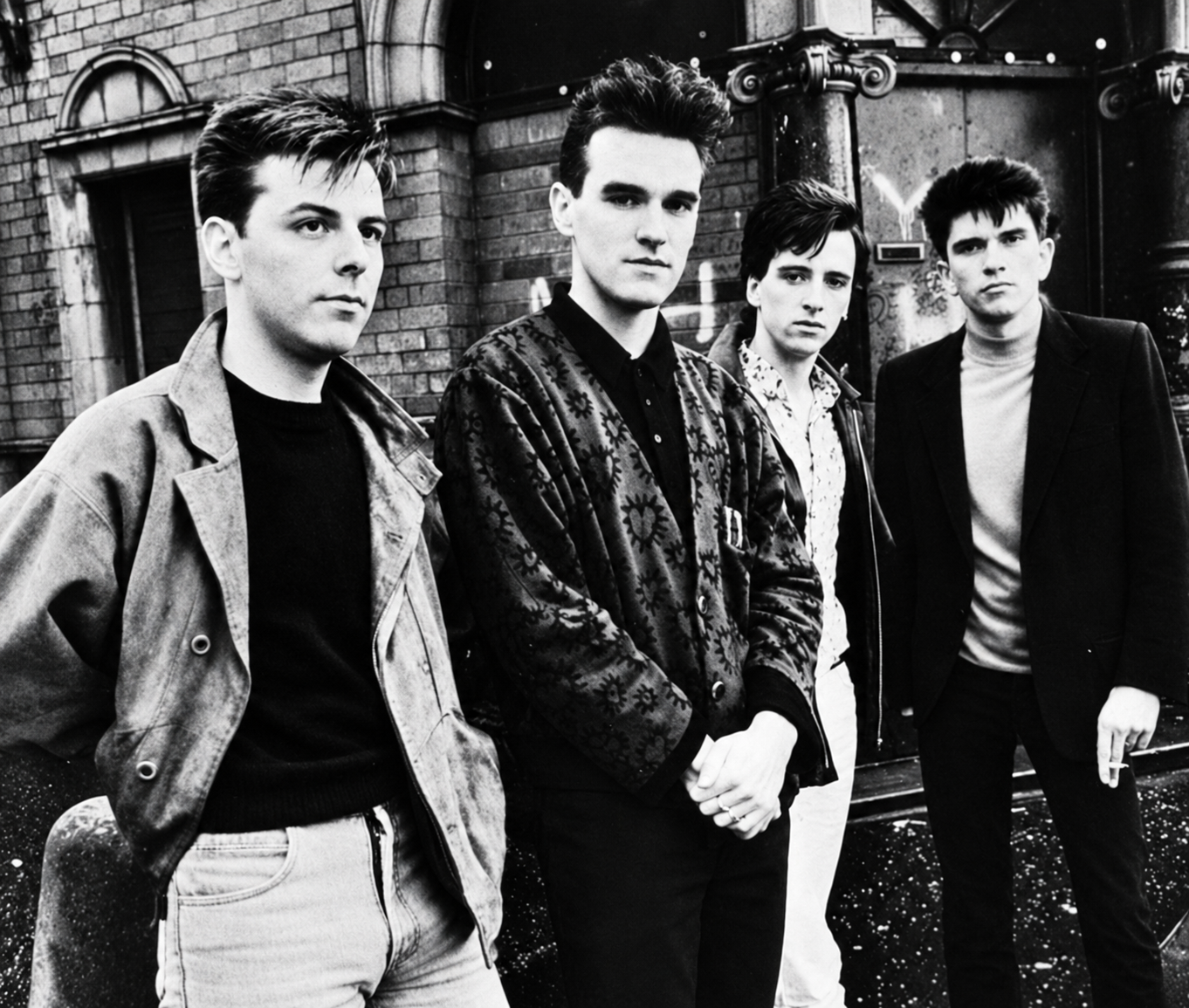
The thing to understand about the founding of The Smiths is that it was not an accident, a chance meeting in a club, or a small ad in a shop window. It was a deliberate act, modelled on a story Johnny Marr had seen in a documentary.
The story was about Jerry Leiber and Mike Stoller, the songwriting partnership behind half the American jukebox of the 1950s, who met in 1950 because one teenager simply turned up at the other's door. Marr — eighteen years old, born John Maher, having changed the spelling of his surname a few years earlier to avoid confusion with the Buzzcocks drummer of the same name — decided this was a reasonable way to start a career. He knew of a man in Stretford who had written a book about the New York Dolls. That was qualification enough.
So on a day in May 1982, Marr went to 384 Kings Road with a mutual acquaintance, Stephen Pomfret, and knocked. Steven Patrick Morrissey, about to turn twenty-three, took his time coming down the stairs.
What happened next is the part that gets skipped in the retellings. Marr didn't pitch. He went up to the bedroom and went through the records — and here is the first thing most people don't know about The Smiths. Faced with a stranger's collection and a need to prove himself, Marr pulled out a 1966 Marvelettes single and played not the A-side but the B-side, then sang along to it. It was a coded message, and Morrissey received it: I know what you know, including the parts nobody else bothers with. They talked for two hours. Marr, recognising the shape of the afternoon, said out loud that this was how Leiber and Stoller had met.
Years later Marr summarised the encounter with a line that explains a great deal about his partner: "I think I thought he was waiting for the world to come to him. And it kind of did."
Two strange apprenticeships
The conventional story has Morrissey as a recluse plucked from his bedroom. It isn't quite true, and the truth is better.
By 1982 Morrissey had already served a peculiar apprenticeship in public. He had run the British fan club for the New York Dolls, recruiting members through small ads in the back pages of the music weeklies. He had bombarded the letters pages of the music press for years. He had written for Record Mirror. And he had published two books with a small Manchester imprint, Babylon Books: a 24-page pamphlet on the New York Dolls in 1981 that sold around 3,000 copies, and James Dean Is Not Dead. It was the Dolls booklet that put him on Marr's radar in the first place — the band exists because Morrissey self-published a fanzine-length book about a failed American glam group.
He had also, briefly, been a frontman. In 1978 he sang for the Nosebleeds, a Manchester punk band, and played a handful of gigs. One of them, at Manchester's Ritz on 8 May 1978, was reviewed in the NME by Paul Morley, who noted that the group had resurfaced "boasting a Front Man With Charisma, always an advantage." Four years before the first Smiths single, the NME had already spotted him. (Morrissey has since disputed that he was ever in the band at all — one of several places where his own account and the documentary record part company.)
Marr's apprenticeship was more conventional but no less thorough: the Paris Valentinos at thirteen, with a school friend called Andy Rourke; then Sister Ray; then White Dice, who entered an NME demo competition and got as far as an audition with Elvis Costello's F-Beat label in 1980 before being turned down; then Freak Party, an instrumental funk group with Rourke on bass and Simon Wolstencroft on drums. Freak Party had everything except a singer, which is precisely why Marr went knocking.
The forgotten bassist and the first gig
The name came from Morrissey, and was a manifesto disguised as a shrug. In an era of synthesiser groups with ornate names, he wanted the plainest one available: "it was the most ordinary name and I thought it was time that the ordinary folk of the world showed their faces."
The first line-up did not include Andy Rourke. The Smiths' original bassist was Dale Hibbert, an engineer at Decibelle Studios in Manchester, and his recruitment was strategic — he came with studio access. In August 1982 the band cut their first demo there, two songs, one of them "Suffer Little Children." Hibbert played the band's debut gig at the Ritz on 4 October 1982, supporting Blue Rondo à la Turk at an event billed as "An Evening of Pure Pleasure," with a friend of Morrissey's, James Maker, dancing onstage in heels. Then he was replaced by Rourke and written out of the story almost entirely.
Hibbert's own recollection contains the single most revealing detail about the band's early months: in all the time he spent with them, Morrissey and Marr played him nothing but early-1960s records. No contemporary reference points at all. The retro-futurism wasn't discovered in the studio; it was the founding condition.
Mike Joyce, meanwhile, arrived via an audition he later admitted to attending while under the influence of psilocybin mushrooms. It went well.
£250 and a nude on the cover
The record that started it was made for £250.
Their manager Joe Moss — a Manchester clothes-shop owner rather than a music-industry figure — paid for a single day at Strawberry Studios in Stockport on 27 February 1983. The band produced it themselves. That was "Hand in Glove."
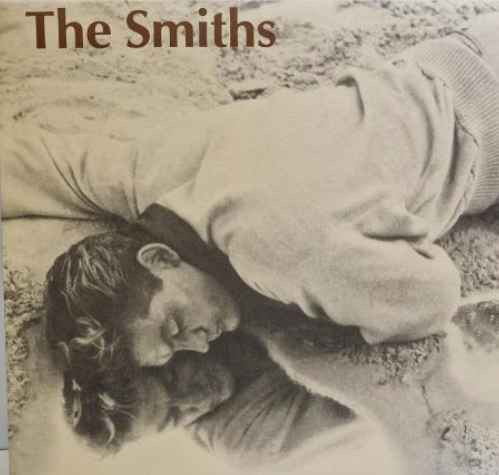
Morrissey put a naked man on the sleeve. The image was a photograph of the bodybuilder George O'Mara, lifted from Margaret Walters' book The Nude Male, and it was chosen precisely for the discomfort it would cause in record shops. It set the template: for the rest of their existence, a Smiths sleeve almost never featured the band.
Instead Morrissey assembled a cast. Joe Dallesandro from Warhol's Flesh on the debut album. Alain Delon, dying, from L'Insoumis on The Queen Is Dead. Shelagh Delaney, the Salford teenager who wrote A Taste of Honey, on Louder Than Bombs. Viv Nicholson — the Yorkshire woman who won a fortune on the pools in 1961 and spent it inside three years — on "Heaven Knows I'm Miserable Now." Pat Phoenix from Coronation Street. Truman Capote, photographed by Cecil Beaton. Candy Darling. Terence Stamp, who objected to being used on "What Difference Does It Make?" — so Morrissey reshot the pose himself and put his own image out instead, which is why the original Stamp sleeve is now the collectable one.
Taken together it's a curated exhibition of outsiders, film stars, kitchen-sink writers and Warhol superstars, issued at seven-inch size to teenagers in provincial towns who had no other route to any of it. The sleeves were an education system.
What Marr was actually doing
Marr's playing is routinely described as jangly, which is roughly as useful as calling a cathedral tall.
Two examples of what was really going on.
"This Charming Man" exists because of professional jealousy. Marr heard fellow Rough Trade act Aztec Camera getting daytime radio play and, in his own words, felt "a little jealous, my competitive urges kicked in." He wrote a bright major-key single deliberately to outchart his own label-mates, composing it the same night as two other songs for a Peel session. The recording carries around fifteen separate guitar tracks. Buried in the mix is a sound made by dropping a metal-handled knife onto a Telecaster that was lying on top of a Fender Twin Reverb amplifier.
"How Soon Is Now?" — the song most people would name as the band's signature — was a B-side, tacked onto the 12-inch of "William, It Was Really Nothing" in August 1984. That tremolo is not an effects pedal. Producer John Porter ran the guitar through three Fender Twin Reverbs (Marr remembers four), each with its tremolo set to a slightly different oscillation speed, and then had to keep them in time with the track by hand: "We went out into the studio and I asked Mark to play the track and we would try and chase it with the speed knobs." Take after take, four men twisting amplifier dials in sync. The pulse was gated using a cowbell from a Linn drum machine as the trigger.
And the slide guitar that answers the vocal throughout? Not Marr. Porter played it himself, on a 1954 Telecaster in open A, because Morrissey would not sing backing vocals and the song needed a second voice. The most famous guitar sound in British indie is a producer standing in for a singer who wouldn't harmonise with himself.
How they got heard without the charts
Here is the statistic that undoes most assumptions about The Smiths: in five years they never had a UK top-five single. Their highest placings while they existed were number 10. "Hand in Glove" didn't reach the national chart at all — it got to number 3 on the independent chart, and the song's first actual hit was Sandie Shaw's 1984 version, which reached 27, with the band backing her and playing barefoot in tribute.
They became enormous anyway, by a route that barely existed before them and became the standard afterwards: John Peel, the independent chart, the music weeklies, and the live circuit. Their first Peel session was recorded on 18 May 1983 and broadcast on 1 June — before they had charted anywhere. (Peel didn't find them; his producer John Walters did, at a London University gig.) Four sessions followed. The compilation of that radio work, Hatful of Hollow, is for many listeners the definitive Smiths record — an album largely assembled from BBC sessions rather than studio albums, which tells you where the band actually lived.
Meat Is Murder went to number one in 1985. It was their only chart-topping album.
What they changed
The influence claim is made so often it has gone soft, so it's worth being specific about what actually transferred.
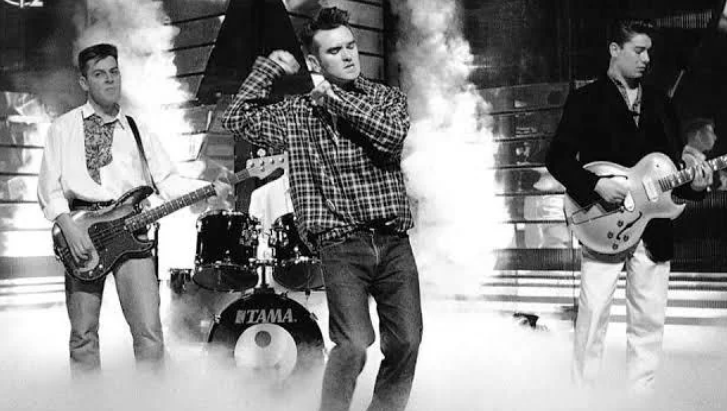
They proved the independent route worked at scale. A guitar band on a small London label, with no major backing, reluctant about videos, largely absent from daytime radio, took albums to the top of the chart during the imperial phase of British synth-pop. Every British indie band of the following twenty years was working from that demonstration.
Marr rewrote the job description of the guitarist. Not solos — interlocking parts, open tunings, capos, layered overdubs, arrangements built like Motown records rather than rock ones. His stated influences were Nile Rodgers, Bert Jansch and the Stooges' James Williamson, an unlikely triangulation that produced something none of them sounded like. Noel Gallagher's assessment, delivered with characteristic economy, was that Marr was a wizard whose style couldn't be copied — which didn't stop a generation of Britpop and post-Britpop guitarists trying.
Morrissey made the provincial sayable. Salford, Whalley Range, the rain, the precinct, the dole. He borrowed openly from Shelagh Delaney and the northern kitchen-sink tradition and put it into pop songs, and in doing so licensed a whole subsequent literature of British songwriting that didn't need to pretend to be American.
And the visual grammar stuck. The borrowed film still, the monochrome crop, the band's absence from its own sleeve — that's now simply what an indie record looks like.
In 2013 the NME polled its writers for the 500 greatest albums of all time. The Queen Is Dead — a record that peaked at number 2 — came first.
The ending, and the bill
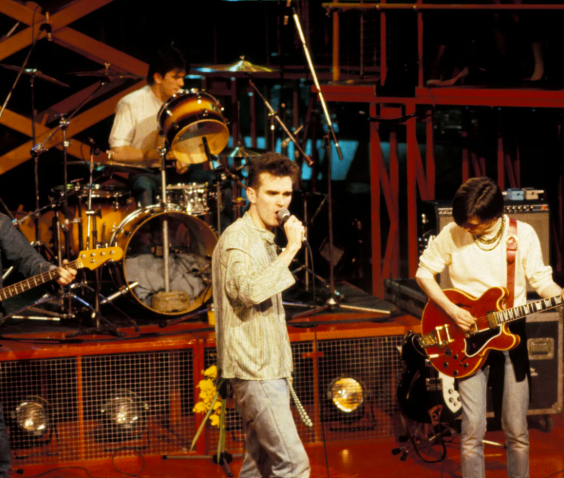
It fell apart in 1987, quickly and badly. Marr left; a piece in the NME announcing a split, which Marr believed had been planted, sealed it.
The wreckage had a specific cause, and it was administrative. When Morrissey and Marr signed with Rough Trade in 1983, they signed on behalf of the band, and nobody discussed how the money would be divided. The arrangement that emerged — 40 per cent each to Morrissey and Marr, 10 per cent each to Joyce and Rourke, agreed verbally and never written down — held for as long as everyone was getting along.
In December 1996 Mike Joyce sued. After a seven-day hearing, Judge Weeks found for him: roughly £1 million in back payments and 25 per cent of future recording and performance royalties. In the course of the judgment he described Morrissey as "devious, truculent and unreliable." Morrissey's appeal failed in 1998. Rourke, by then in financial trouble, had already settled for a lump sum and kept his 10 per cent — a decision that cost him a fortune and which he seems to have borne with more grace than anyone else involved.
There has never been a reunion, and there never will be one. Andy Rourke — the melodic heart of the band, the man who played the bassline on "Barbarism Begins at Home" and whom Morrissey once sacked by leaving a note on his car windscreen, only to reinstate him a fortnight later when his replacement couldn't play the parts — died in New York on 19 May 2023, aged 59.
What survives is five years of records made by four young men from south Manchester, at least one of whom knocked on a door because of something he'd seen in a documentary about two songwriters from Los Angeles.
Sources
- The Smiths — Wikipedia
- Knocking on Morrissey's Door — TIME
- Johnny Marr on meeting Morrissey — Tony Fletcher
- Johnny Marr — Wikipedia
- Morrissey — Wikipedia
- The Nosebleeds — Wikipedia
- Dale Hibbert interview — Pennyblackmusic
- Hand in Glove — Wikipedia
- This Charming Man — Wikipedia
- How Soon Is Now? — Wikipedia
- John Porter on recording How Soon Is Now? — Guitar World
- The Smiths' cover stars — Radio X
- The Smiths discography — Wikipedia
- Smiths Peel Sessions — John Peel Wiki
- Joyce v Morrissey & Ors
- These charmless men — Irish Times
- Andy Rourke — Wikipedia
- The Queen Is Dead tops NME's 500 Greatest Albums
The sleeves were an education system.